TEKNOFEST Havacılıkta Yapay Zeka — UAV Real-Time Perception System
As Team Captain for TEKNOFEST 2026 Havacılıkta Yapay Zeka Yarışması, I led a multi-person engineering team building an end-to-end perception system for a UAV competition scored across three subsystems: object detection, position (visual odometry) estimation, and reference-object matching. I defined the shared system architecture, directed task ownership across the team, and personally built the reference-matching pipeline and the real-time competition client that unifies all three subsystems behind the server's JSON submission API.
mAP50
0.749
Reference-object matching, full video evaluation
Inference speed
~36ms/frame
Reference-matching engine (YOLOv8)
VO throughput
~7.5 FPS
Real-time visual odometry on drone footage
Training dataset
0,000+ images
4-class UAV object-detection dataset
Team size
0 engineers
Cross-functional team across 3 subsystems
Project Gallery
Problem
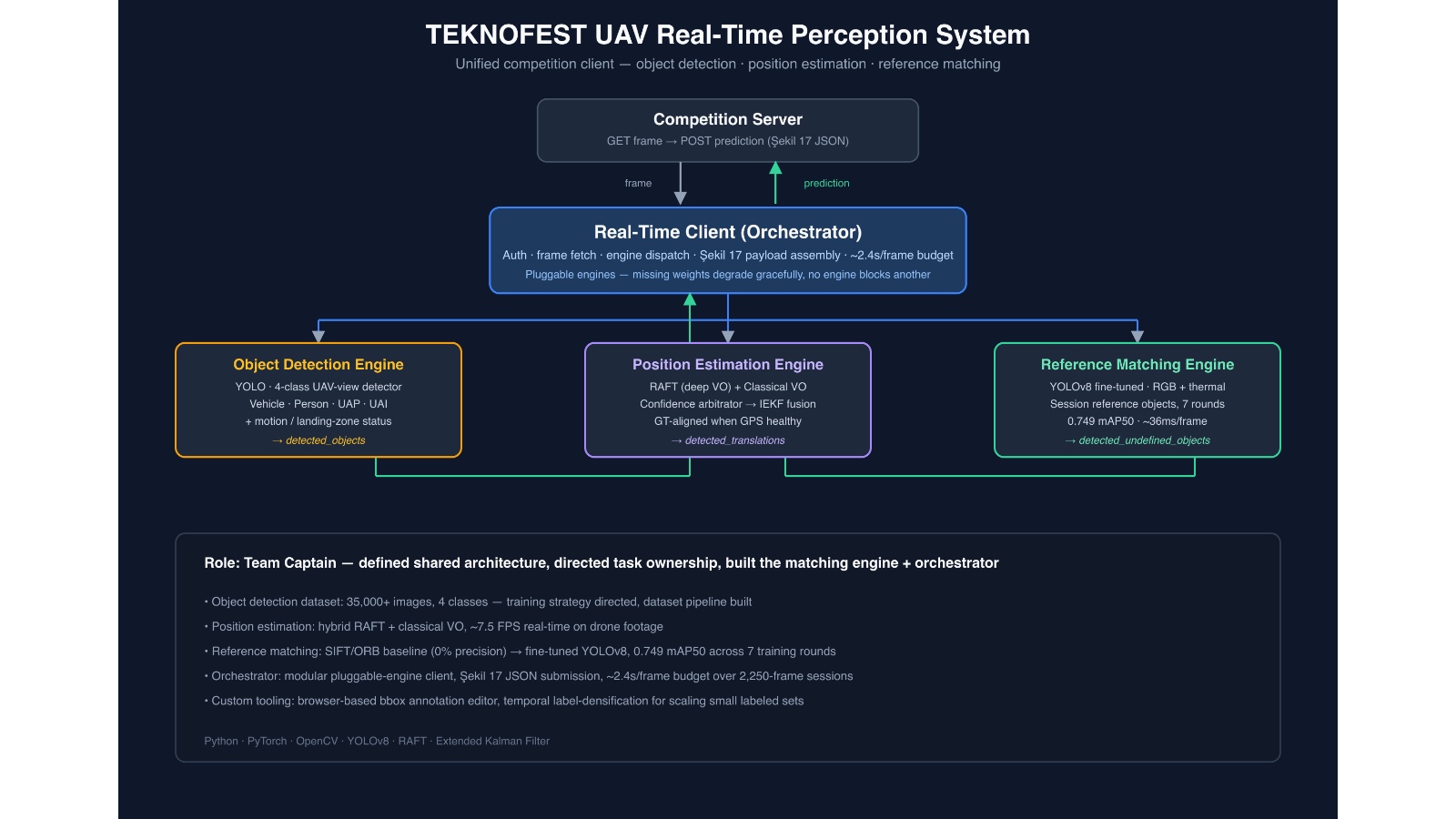
National UAV-AI competitions require teams to process live aerial video and return structured predictions to a scoring server within tight per-frame time budgets (~2.4s/frame over a 90-minute, 2,250-frame session). No single off-the-shelf model handles this — it requires object detection, position estimation without reliable GPS, and open-set matching against session-specific reference objects, all fused into one real-time client the server can talk to.
Challenge
Key challenges: (1) the initial classical SIFT/ORB baseline for reference-object matching produced 0% precision on real footage; (2) reconciling two independent motion-estimation sources (learned RAFT flow vs. classical optical flow) into one trustworthy position estimate when GPS health degrades; (3) building and maintaining a 35K+ image multi-class training dataset under inconsistent, throttled data delivery; (4) integrating three independently-developed subsystems behind a single real-time, spec-compliant JSON protocol without any one subsystem blocking the others.
Contributors
Architecture
How the pieces fit together.
A modular "pluggable engine" architecture: a central real-time client authenticates with the competition server, fetches frames, and dispatches each frame to three independent inference engines — an object-detection engine (YOLO, 4-class UAV-view detector), a position-estimation engine (hybrid classical optical-flow + RAFT-based deep VO, fused via a confidence-aware arbitrator and filtered through an iterative Extended Kalman Filter), and a reference-matching engine (fine-tuned YOLOv8 detecting session-specific reference objects in RGB/thermal imagery). Each engine is independently swappable and degrades gracefully if its weights aren't available. Results are assembled into the competition's spec-defined JSON submission format and posted back to the server per frame under a fixed time budget.